Gloria Dies
A Dog's JourneyGloria’s death unfolds in her room through a gradual change in her breathing, and Toby’s sharp bark ensures that CJ is awake to witness her mother’s final moments. The event turns on a small but consequential act of attention: Toby recognizes what is happening, wakes CJ, and stays with her as she says goodbye and begins to grieve.
The Signs of Passing and Toby’s Intervention
About a week after the preceding conversation, Toby is sitting at CJ’s feet in Gloria’s room when he senses a change. Gloria’s breathing grows lighter, stops, and resumes in a couple of deep breaths. The pattern repeats, but each cycle is weaker, and each exhalation gentler. The scene makes the approach of death perceptible through diminishing bodily movement rather than through an announcement from another person. Toby understands the change as Gloria passing.
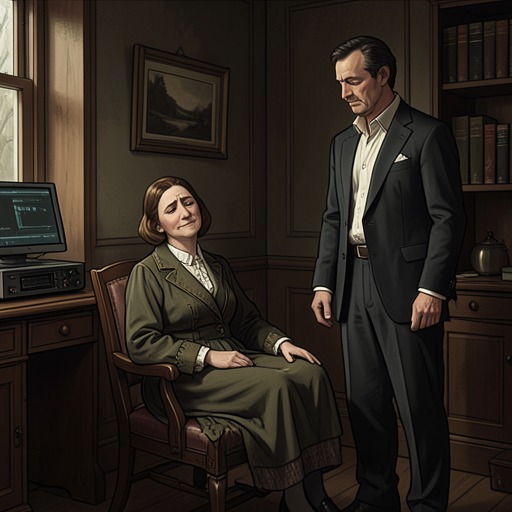
He jumps onto the chair beside her and looks at her face. Gloria’s eyes are closed, her mouth is open, and her hands are clutched across her chest. CJ is asleep. Toby looks back at her and recognizes that she would want to be awake; his response is a single, sharp yip, which sounds especially loud in the silent room. The bark is brief, but it changes what CJ can do: instead of learning of the death after it has happened, she can come to Gloria’s side while her mother is still alive.
The moment also establishes Toby as an attentive presence within the family’s grief. He does not explain Gloria’s condition or try to direct CJ’s response. He notices a bodily change, attends to Gloria, then turns his attention to the sleeping CJ and acts to bring her into the moment. His care takes the form available to him: alertness, a bark, and physical closeness.
CJ’s Farewell
CJ wakes with a start and asks Toby, “What is it, Toby?” She stands and comes beside him. Toby lifts his nose and licks her fingers; CJ responds, “Oh.” The exchange is spare, but it marks her recognition of what Toby has brought her to see. The scene gives her no extended explanation or preparation: her movement from sleep to understanding happens in the room, beside Gloria.
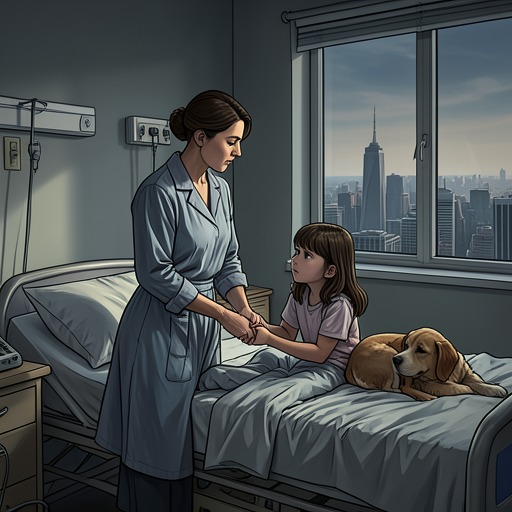
After a moment, CJ reaches down and clutches Gloria’s hand in hers. Tears fall from her eyes, and Toby can feel her pain. The handclasp makes the farewell physical before CJ gives it words; she and Toby remain beside Gloria together for several minutes. CJ finally says, “Good-bye, Mom,” and, “I love you.” Her words acknowledge both the separation taking place and the bond that persists in the act of saying goodbye. The brief pause before she speaks leaves room for her to be present with Gloria rather than reducing the moment to a single declaration.
Death and Its Immediate Aftermath
Gloria takes her last breath and fades away. CJ then returns to her chair and sits down. That movement marks the change from keeping vigil beside her mother to facing the first moments after her death. Toby jumps into CJ’s lap and curls up; she holds him and rocks softly. Where his earlier bark summoned her to Gloria, his presence now supports her after the farewell. The scene’s sequence gives his companionship a clear practical shape: he helps CJ be awake for the death, remains with her at the bedside, and stays close as she grieves.
The event is narrated through Toby’s attention to breathing, posture, touch, and tears. Gloria’s passing is registered first as a weakening rhythm; CJ’s grief becomes visible in her tearful face, her grasp of her mother’s hand, and the way she holds Toby afterward. The movement from the quiet room to Toby’s sharp yip and then to the soft rocking in the chair gives the scene its emotional turn: the loss cannot be prevented, but CJ does not meet its final moment alone. Toby’s alertness enables the farewell, while his closeness offers comfort once there is nothing left to say.